By clicking “Accept All Cookies”, you agree to the storing of cookies on your device to enhance site navigation, analyze site usage, and assist in our marketing efforts. View our Privacy Policy for more information.
Stop Chasing Back Pain: How to Unlock Your Spine for Heavy Lifts
Back pain isn’t always a strength issue, it’s a control issue. Learn the 3 spinal articulation drills used by athletes to restore movement, protect the lumbar, and lift heavy.
By
June 4, 2026

Strength Without Mobility Is a Liability: Fixing the Root Cause of Back Pain
If your back feels like a solid block of concrete every time you get under a barbell, you don’t have a "tight" back, you have a frozen one.
Most lifters try to stretch their way out of pain, but passive stretching is a band-aid. If you can't control your spine, your body will protect itself by locking you down, killing your power and making every hinge feel like a gamble.
At Ignite Athletic Club, we don't move for the sake of moving. We move to perform. To fix back pain and stop the "mystery" aches, you need to regain spinal articulation. If you can’t move your vertebrae segment by segment, your lower back will eventually pay the price.
Here is the protocol to unstick your spine and get back to training without the handbrake on.
1. Segmented Cat-Cow for Spinal Control
Standard Cat-Cow is for yoga warm-ups. Segmented Cat-Cow is a neurological reset. Most athletes have blind spots, or areas of the spine that move as one fused chunk. This drill exposes them and forces individual vertebral movement.
- The Drill: Start on all fours. Instead of a global arch, move exclusively from the tailbone. Slow it down. Tuck the pelvis, then the lumbar, then the thoracic, then the neck.
- The Goal: Move one bone at a time. If a section "clumps" together, stop. Breathe into that segment and force the articulation.
- Why It Matters: If you can’t segment your spine at zero load, you’ll lose your midline stability when it matters most under a heavy load.
2. Quadruped Thoracic Rotation for Mid-Back Mobility
Your thoracic spine (mid-back) is built to rotate. When it’s locked up from sitting or poor programming, your lower back tries to compensate. The lumbar spine isn't built for rotation, that's how you end up with tweak injuries during dynamic movements.
- The Drill: From all fours, hand behind the head, elbow to opposite wrist. As you rotate toward the sky, keep your glutes locked and your pelvis dead-center.
- The Focus: Do not let your hips shift. If your hips move, you’re cheating. The rotation must come from the ribcage.
- The Performance Benefit: Better T-spine rotation creates a stable overhead position and allows for massive power transfer in rotational movements like med ball slams or cleans.
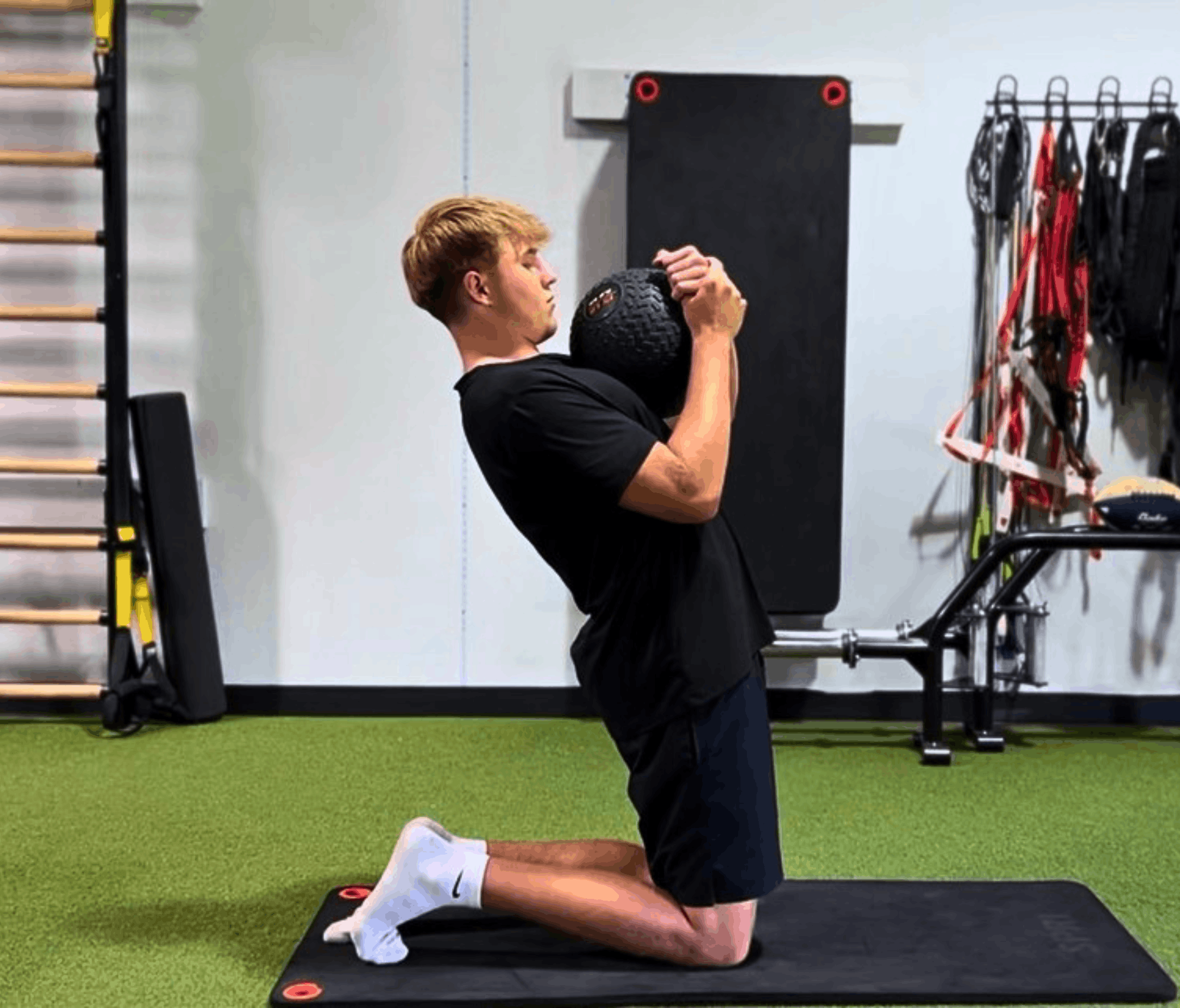
3. Kneeling Thoracic Rotation for Lumbar Stability
This is the ultimate "no-BS" mobility test. By sitting back on your heels, you physically lock the lumbar spine, forcing your mid-back to do 100% of the work without using your lower back to fake the range of motion.
- The Drill: Sit back on your heels, one forearm pinned to the floor. Use the other hand to rotate your chest open toward the ceiling.
- The Reality Check: You will likely find your range of motion is significantly shorter here. That’s your true mobility.
- The Fix: Clearing this specific restriction is the fastest way to relieve the "heavy" pressure in your upper back and shoulders that plagues your bench and overhead press.
The Ignite Standard: Consistency beats intensity. Use this protocol as a pre-lift primer or a recovery tool. You can’t build a high-performance body with a stiff spine. Move better, lift heavier.
Stop Training Around the Pain
Stop guessing and start lifting. If you’re ready to bridge the gap between "stiff" and "strong," let’s find exactly where your movement is breaking down. Click here to schedule your Free Assessment and get a professional eyes-on evaluation of your spinal mobility.