By clicking “Accept All Cookies”, you agree to the storing of cookies on your device to enhance site navigation, analyze site usage, and assist in our marketing efforts. View our Privacy Policy for more information.
Clean Up Your Overhead Press: 3 Drills for Stable, Pain-Free Pressing
Can’t get your arms overhead without arching your back? Master the Down Dog to Up Dog flow, YTA Raises, and Active Hangs to fix your overhead mobility and lift heavy.
By
July 2, 2026
Related

The Overhead Deficit: Why Your Shoulders (and Back) Are Fighting You
If you have to lean back to finish a shoulder press or a snatch, you have a massive performance leak. Most lifters blame tight shoulders, but the problem is usually a combination of a stiff mid-back and a lack of control in the muscles that stabilize the shoulder blades. When you force an overhead position you don't actually own, your lower back arches to compensate, putting your spine in the crosshairs.
At Ignite Athletic Club, we build active overhead capacity. We want you to own the space above your head so you can transfer power from the floor to the lockout without losing your midline.
Here is the protocol to open your overhead and stabilize your press.
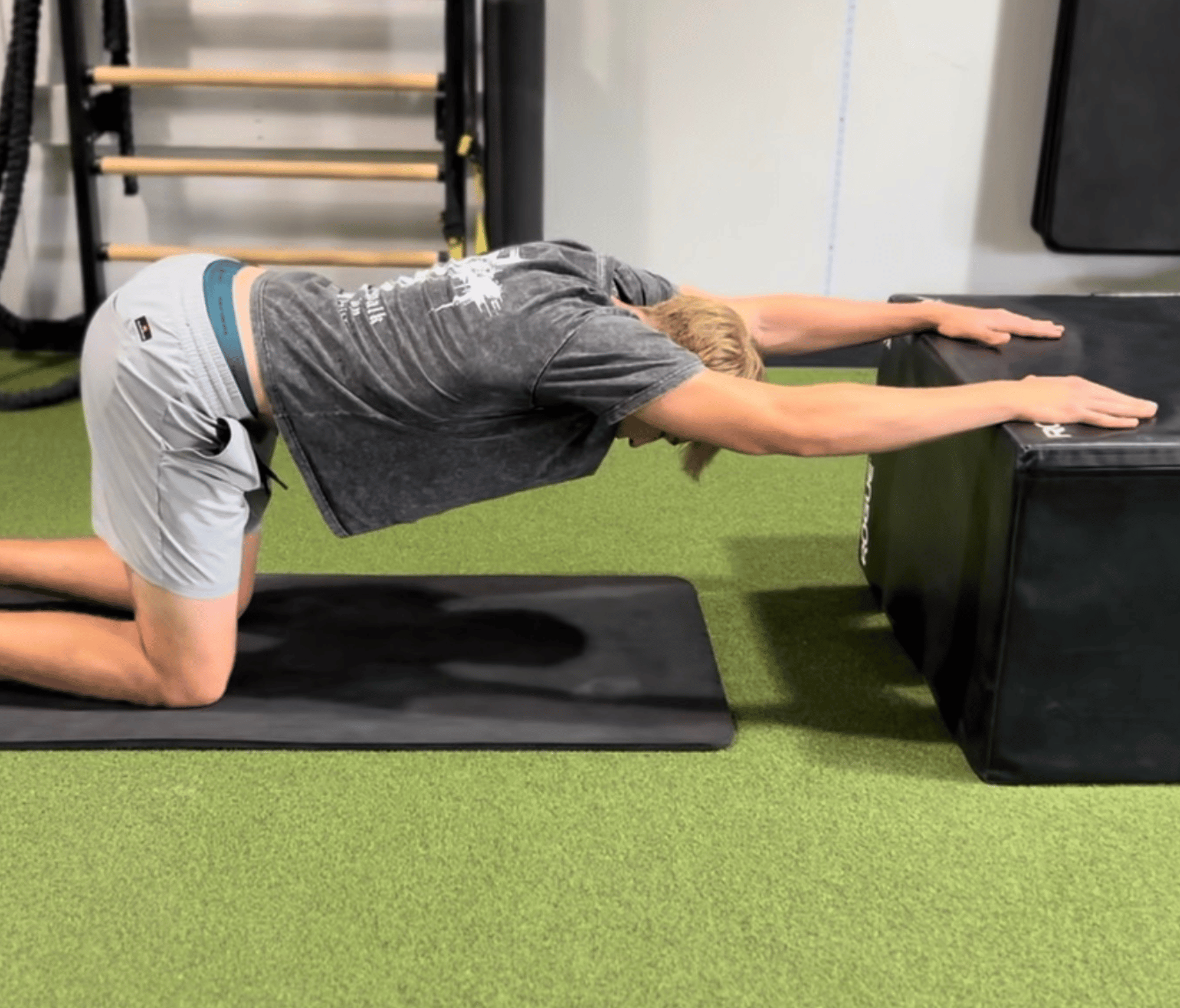
1. Down Dog to Up Dog for Full-Line Integration
This isn't a flow for relaxation; it’s a drill for active shoulder extension and spinal transition. It forces your shoulders to support your weight while moving from a closed hip to an open anterior chain.
- The Drill: Start in a plank. Push your hips back into Downward Dog, driving your chest toward your knees and your heels toward the floor. Then, sweep through, dropping your hips toward the floor and pulling your chest high into Upward Dog.
- The Goal: In the Down Dog position, push the floor away as hard as you can. Think about "opening" your armpits toward your toes. In Upward Dog, pull your shoulders away from your ears. Don't collapse.
- Why It Matters: This integrates shoulder mobility with thoracic (mid-back) extension. It teaches your shoulders to stay stable while the rest of your body transitions through different ranges of tension.
2. YTA Raises for Scapular Control
If the small muscles that control your shoulder blades are "sleepy," your big prime movers (like your traps and delts) will take over, leading to impingement. YTA raises wake up the lower traps and rhomboids.
- The Drill: Lie face down on the floor. Move your arms into a "Y" position (thumbs up), then a "T" position (palms down), then an "A" position (palms up by your hips), lifting your hands off the floor in each spot.
- The Focus: Do not use your lower back to lift your chest. Keep your forehead pinned to the floor. The lift should come entirely from the muscles around your shoulder blades.
- The Performance Benefit: This builds the "backside" support system. A strong "YTA" translates directly to a more stable overhead lockout and better posture during heavy carries.
3. Active Hang for Structural Integrity
Passive hanging is for stretching; Active Hanging is for building a bulletproof shoulder. It teaches the lats to lengthen while the rotator cuff stays engaged, creating a "packed" and protected joint.
- The Drill: Grab a pull-up bar with an overhand grip. Instead of just "dead hanging," pull your shoulder blades down and back, away from your ears. Your arms should stay straight, but your ears should be "moving away" from your shoulders.
- The Reality Check: Hold for 30 seconds. If you feel your shoulders creeping up to your ears, you’ve lost the active engagement. Relax, reset, and go again.
- The Fix: This clears up the space in the shoulder joint and strengthens the grip and the "bottom" of the overhead position. It’s the single best drill for athletes who feel "pinched" at the top of a pull-up or press.
The Ignite Standard: Consistency beats intensity. Use this protocol as a pre-lift primer or a recovery tool. You can’t build a high-performance body with a stiff spine. Move better, lift heavier.
Stop Training Around the Pain
If you’re ready to stop making excuses for your stiff shoulders and start hitting PRs without the "day-after" ache, you need a plan that works as hard as you do. Join the 30-Day Personal Training Blueprint and get the mobility tools, strength programming, and expert coaching you need to dominate your goals.