By clicking “Accept All Cookies”, you agree to the storing of cookies on your device to enhance site navigation, analyze site usage, and assist in our marketing efforts. View our Privacy Policy for more information.
Stop Pulling Your Hamstrings: 3 Moves for Explosive Strength and Length
Tight hamstrings are a liability, not a badge of honor. Master the Elephant Walk, Eccentric Hamstring Stretch, and Inchworm Walkout to unlock your hinge and protect your back.
By
June 25, 2026
Related

The Hamstring Illusion: Why Your "Tightness" is Actually a Weakness
If you feel like your hamstrings are about to snap every time you reach for a deadlift bar, you don't have "short" muscles. You have a nervous system that doesn't trust your hamstrings. When your brain senses weakness or instability, it creates tension to protect the joint. This is why passive stretching never sticks.
To fix tight hamstrings, you have to move them under load and through range. At Ignite Athletic Club, we prioritize active lengthening. If your hamstrings can’t handle tension while they’re stretching, they will always feel tight, and your lower back will always be forced to pick up the slack during your heavy hinges.
Here is the protocol to build resilient, long, and powerful hamstrings.
1. The Elephant Walk for Active Neural Flossing
This is the ultimate drill for athletes with "locked" hamstrings. It combines a deep hinge with active knee extension, forcing the hamstrings to lengthen while the antagonist muscles (the quads) are working.
- The Drill: Fold forward and place your hands on a bench, a box, or the floor. Keep your chest close to your thighs. Alternately straighten one leg while keeping the other slightly bent.
- The Goal: Contract your quad as you straighten the leg. This uses reciprocal inhibition to force the hamstring to release. You should feel a deep stretch, not a sharp pain.
- Why It Matters: This "flosses" the sciatic nerve and the hamstring simultaneously. It’s the fastest way to increase your toe-touch range without losing the "snap" needed for explosive movements.
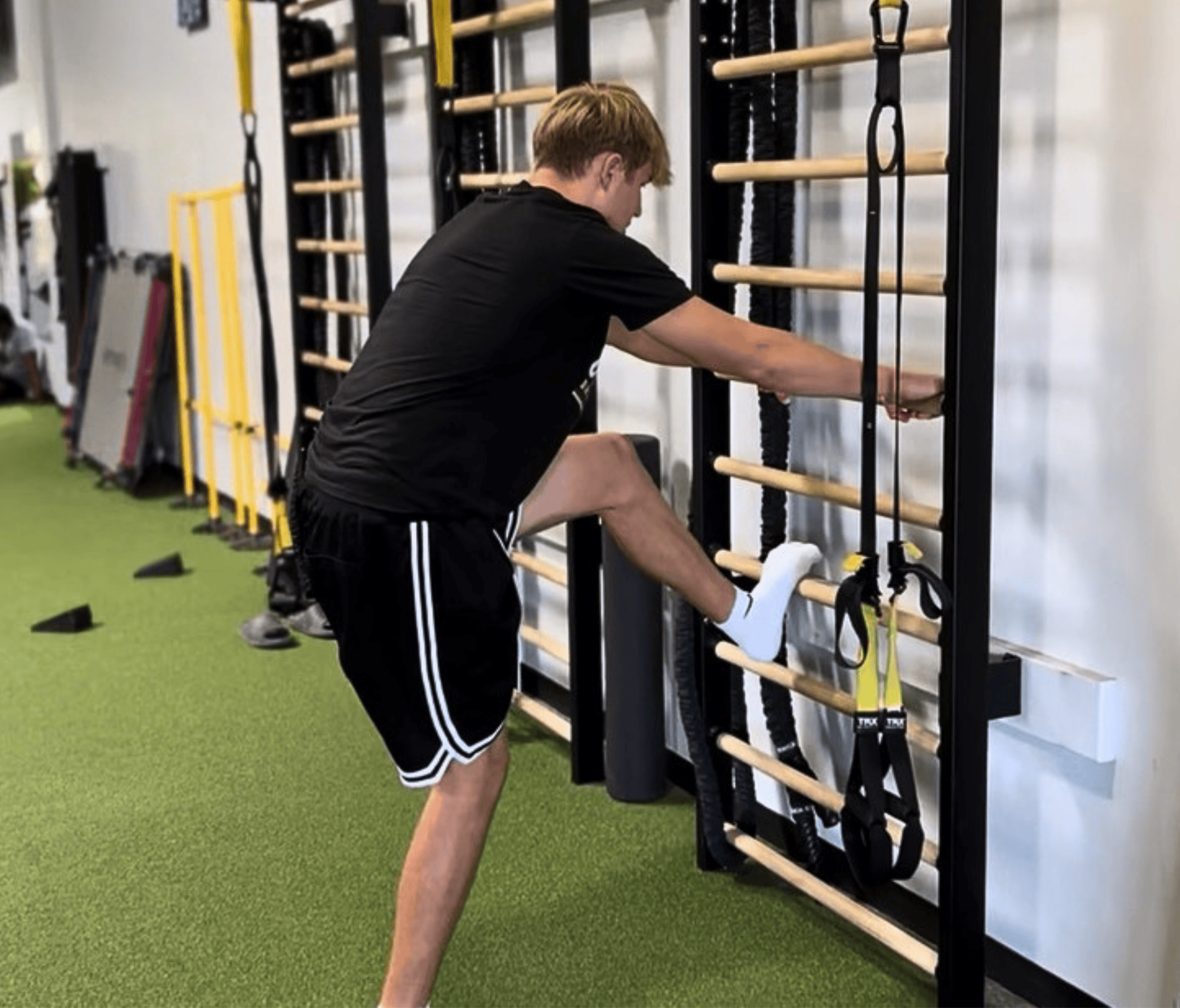
2. Eccentric Hamstring Stretch (Box-Elevated)
Static stretching is a band-aid. This eccentric stretch teaches the muscle to produce force while it is being lengthened. By elevating the foot, you isolate the hamstring and control the descent, which is the secret to preventing tweaks during sprints or heavy cleans.
- The Drill: Place your heel on a box or bench in front of you. Keep a very slight "micro-bend" in that knee. Slowly hinge at the hips, pushing your glutes as far back as possible while keeping your spine long and your chest up.
- The Focus: Go slow! Count to 4 as you push your hips back. You should feel the tension build in the belly of the muscle. Do not round your back to reach further, the stretch comes from the hip displacement.
- The Performance Benefit: This builds long-muscle strength. It ensures that when you’re at the bottom of a heavy deadlift or hitting a full-speed stride, your hamstrings are actually producing power rather than just hanging on for dear life.
3. Inchworm Walkout for Total Posterior Integration
The Inchworm is a dynamic test of how your hamstrings, glutes, and lower back work together. It forces the anterior chain to stabilize while the posterior chain reaches terminal length.
- The Drill: From a standing position, hinge down and touch the floor. Walk your hands out into a plank position, then, while keeping your legs as straight as possible, walk your feet back toward your hands.
- The Reality Check: Do not let your knees bend. If you have to bend your knees to move your feet, you’ve reached the end of your functional range. Small, inch-long steps with your feet are the key.
- The Fix: This move integrates hamstring length with core stability. It teaches your body to maintain a neutral spine even when the hamstrings are under maximum tension, which is the cornerstone of a safe, heavy hinge.
The Ignite Standard: Consistency beats intensity. Use this protocol as a pre-lift primer or a recovery tool. You can’t build a high-performance body with a stiff spine. Move better, lift heavier.
Stop Training Around the Pain
Trade the "stiff" hamstrings for explosive power. You don't need more "recovery" days; you need a better movement profile. Click here to schedule your Free Assessment and let’s build a foundation for your next big PR.